

Types of Electric Vehicles
There are three main types of electric vehicles (EVs) on the roads today.
It is worth noting that EV battery ranges can vary depending on weather conditions; for example, cars have to work harder to run in colder temperatures; also, using the defrost or heat is more likely, decreasing range. Also, at-home charging times depend on how you charge at home (120 volts versus 240 volts). These are caveats you will want to consider when shopping for an electric vehicle.
View an Electric Vehicle Technology Overview Video >
Federal Tax Credits and State Incentives
EV owners may be eligible for federal tax credits for your EV charger.
Alternative Fuel Vehicle Refueling Property Credit >
Michigan also offers state incentives and laws to residents.
Michigan Laws and Incentives >
Types of EV Chargers
There are many factors that affect how quickly your EV will charge, including, but not limited to, the charging equipment, the batteries and temperature. Charging equipment can be referred to by several names: charging station, charging port, or more simply, a charger. There are 3 chargers available on the market. The US Department of Transportation offers more in-depth information about charger types and speeds.
Level 2 EV Charger Rebate
When you purchase a battery electric vehicle, it will likely come with a Level 1 Charger. These chargers will add approximately 1-10 miles of range to your battery for every hour of charging.
For LL&P residential customers looking for a faster, more efficient charging experience, LL&P offers a $350 rebate for the purchase and installation of an EV Level 2 charger. Level 2 chargers require the installation of an EVSE (requiring a 240V electrical connection).
Qualifications
- Must be a Lowell Light & Power residential customer
- Must be a Level 2, 240-volt charger
- Copy of charger invoice/receipt indicating make, model, payment in full, and date of purchase and installation required
- Copy of vehicle registration required
- Must agree to be placed on the Residential Time-of-Use Rate (RT 130)
Important Details
- Electric vehicle registration and LL&P account must have the same address.
- The rebate application can only be signed by the LL&P account holder.
- Customers requesting a rebate must agree to be placed on the Residential Time-of-Use (TOU) rate with the understanding that all power used within the home is subject to the TOU rate schedule. There is not a separate rate for only the charger.
- The TOU rate (RT 130), consisting of on-, off-, and super off-peak timeframes, replaces the existing residential rate (RS 111/121) for the entire house.
- The TOU Rate will be in effect for no less than 12 consecutive billing cycles.
Time-of-Use Rate
What is the TOU Rate?
The Residential Time-of-Use (TOU) Rate is based on customer electric consumption during Summer and Winter Rate periods. The TOU Rate (RT 130) is an opt-in rate for residential customers. All customers are placed on the standard rate (RT 111/121) when they start service and would need to complete the Time-of-Use Rate Request form below to be switched to the TOU Rate.
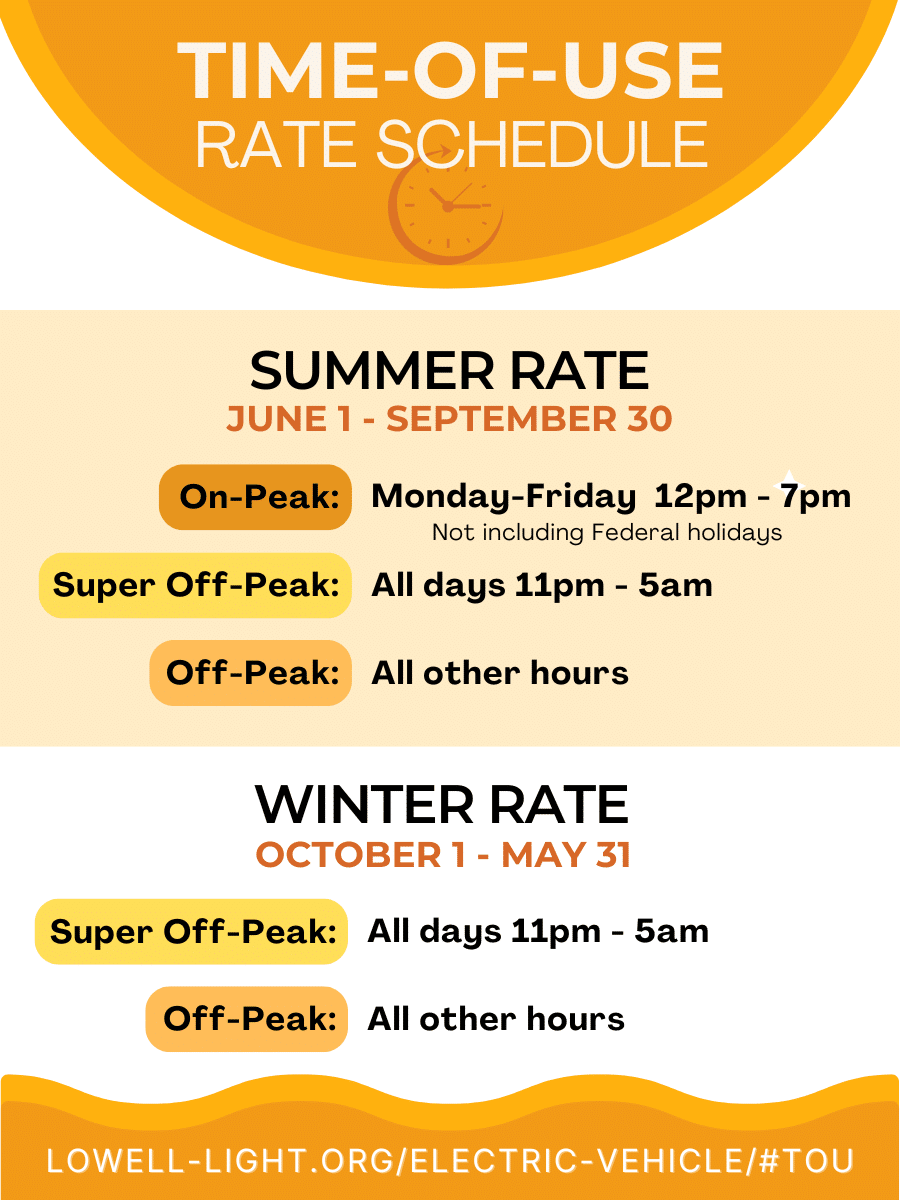
During the Summer Rate period (June 1st through September 30th), there are three rates in effect: On-Peak, Super Off-Peak and Off-Peak. The rates are highest during On-Peak hours (when the majority of people are using the most electricity), and are lowest during Super Off-Peak hours (when most people are not using much electricity.) The Off-Peak hours are the hours that do not fall under On-Peak or Super Off-Peak periods.
On-Peak hours during the Summer Rate period are from 12:00 p.m. (Noon) to 7:00 p.m. except for Saturdays, Sundays, and observed Federal holidays (Independence Day and Labor Day). Super Off-Peak period is from 11:00 p.m. to 5:00 a.m. All other hours are considered Off-Peak.
During the Winter Rate period (October 1st through May 31st), there are only two rates in effect: Super Off-Peak and Off-Peak. There is no On-Peak rate because the level of electricity usage is not as high during the Winter Rate period as it is during the Summer Rate period. The rates are lowest during Super Off-Peak hours.
Super Off-Peak hours are from 11:00 p.m. to 5:00 a.m. All other hours are considered Off-Peak.
How Do I Use the TOU Rate to My Benefit?
The TOU rate schedule will benefit those who are able to shift using electricity from the On-Peak hours to the Super Off-Peak hours, when rates are at their lowest. Activities to shift could include: charging your EV, running the dishwasher, washing or drying clothes, etc. By charging your EV during Super Off-Peak hours, you will save anywhere from $.01 to .09 per kWh! Each household must determine the best routine for their family, and decide if the TOU Rate Schedule is right for them.
NOTE: Households are not required to purchase a Level 2 charger or receive our rebate to sign up for the TOU Rate.
Time-of-Use Rate Request
"*" indicates required fields